Cursive Y
How to write uppercase Y and lowercase y in cursive, one stroke at a time.
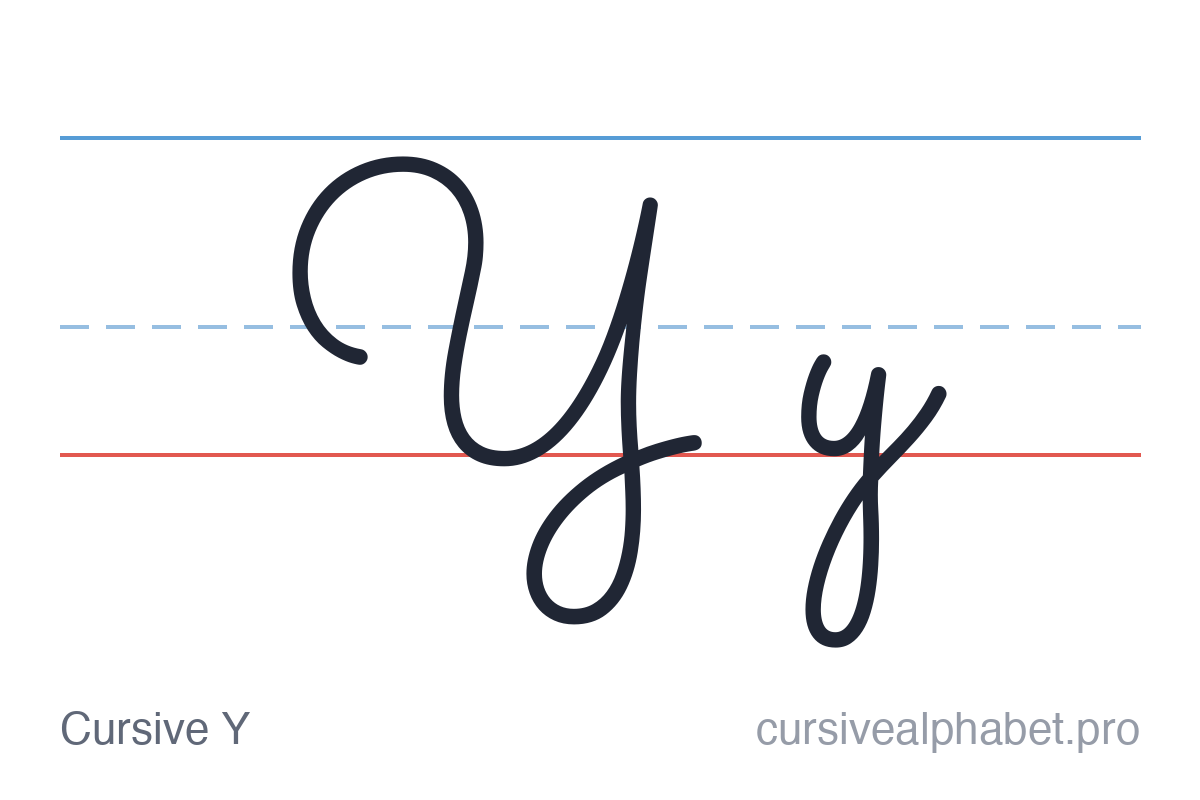
Cursive y is a u that drops below the line. Its top is the u-shape (or an overcurve followed by an undercurve), and its second stem continues down into a loop that swings to the left and returns through the baseline, exactly like g and j. The capital Y is the same shape scaled up to the top line.
- Stroke family
- Overcurve letters
- Height
- y is a descender letter — part of it drops below the baseline. y and the other descender letters
- Joins the next letter
- Lowercase: yes, from the baseline. Capital: yes. The baseline join y uses
How to write a lowercase y in cursive
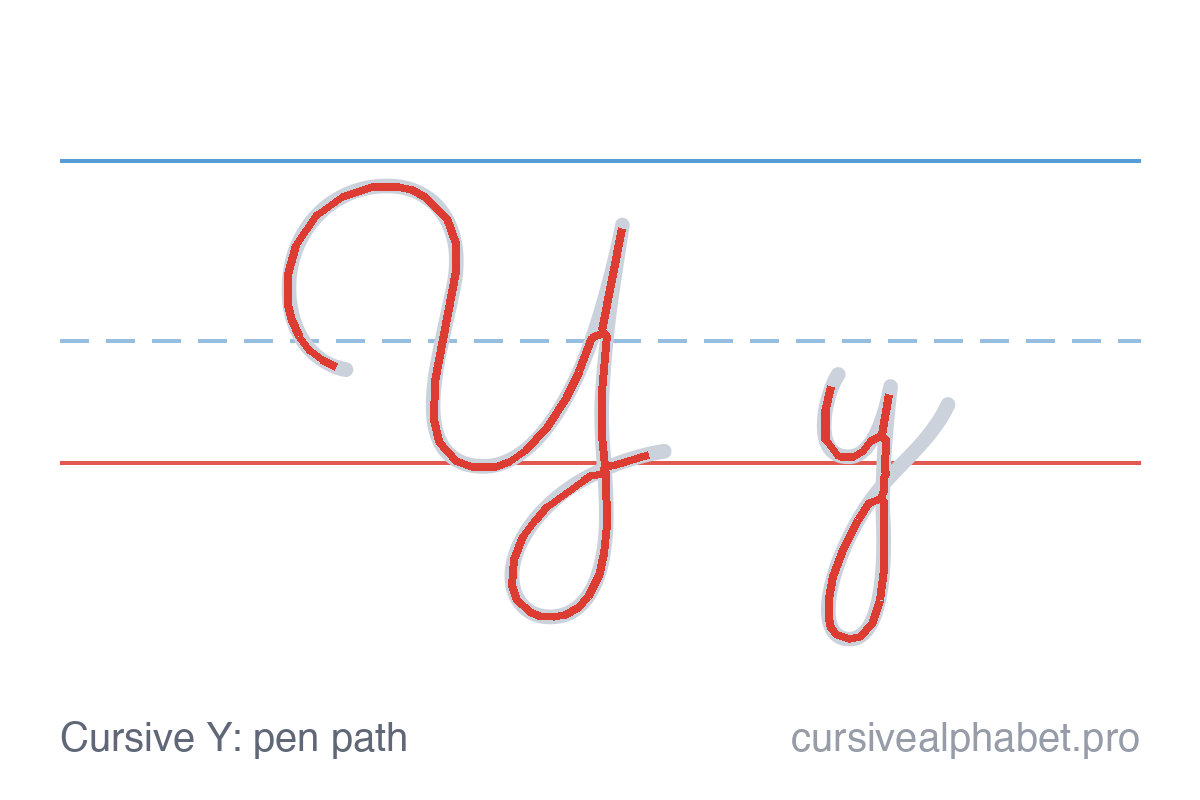
Start at the midline; finish at the baseline, with an exit tail. One continuous stroke.
- Start at the midline; in a word, the joining stroke from the letter before brings you there.
- Slant down to the baseline and undercurve back up to the midline.
- Come straight back down the same line, through the baseline, into the descender space.
- Loop to the left at the bottom and come back up, crossing the stem at the baseline, then finish with an undercurve to the midline.
Trace cursive y on screen with a finger or mouse — the board tells you if you start in the wrong place or go the wrong way.
Lowercase cursive y — numbers mark where each part of the stroke begins
Capital cursive Y — numbers mark where each part of the stroke begins
How to write a capital Y in cursive
Start on the left, with a small curl; finish at the baseline, with an exit tail. Capital Y ends with an exit stroke, so it joins the lowercase letter that follows without lifting the pen. Y beside the other capitals that join
- Start at the midline on the left with a small curl and rise over to the top line.
- Slant down to the baseline and undercurve back up to the top line.
- Come straight back down the same line, through the baseline, into the descender space.
- Loop to the left and come back up, crossing at the baseline, then finish with an undercurve to the midline.
Common mistakes with cursive Y
- Looping to the right, which produces a shape closer to a backward f.
- Making the top too pointed — the bowl of y is rounded like u.
- Letting the loop cross above the baseline so the next letter starts too high.
Tips that help
- Write "uy" together: they start identically and only the descender differs.
- The loop should be the same depth as the g loop so "gy" and "yg" line up.
Easy to mistake for g
g begins with a closed oval; y begins with an open cup, like a u, before it drops below the line. Cursive g
Can you tell g from y at a glance? Take the reading test · Print a comparison practice sheet
Practice words with y
Once the letter is comfortable on its own, write it inside words — that is where the joins happen. Watch how the exit tail of y rises to meet the next letter.
Want different words? Type a spelling list into the generator and print your own y sheet (letters A–Z and numbers, up to 24 lines of any length, US Letter or A4), or copy more words that use y from the word lists.
Free cursive Y worksheet
Capital Y and lowercase y: a model to copy, grey letters to write over, dotted letters to trace, two practice words, and blank rows to finish on your own. Prints on one US Letter page.
Cursive Y practice sheet
Uppercase Y · lowercase y · yes · yak
Name ______________________ Date __________
Capital Y
Lowercase y
Together
Words
On your own
cursivealphabet.pro — free cursive practice sheets
y and its stroke family
Overcurve letters begin with an arch that comes over the top from the left: m, n, v, x, y and z. The hump is the whole skill — keep it round, not pointed.
Families are also the order to learn in, rather than A to Z: the beginner’s guide covers when y is usually taught and the four strokes every letter is built from.
Cursive Y questions
How do you write a lowercase y in cursive?
Overcurve to the midline, slant down and undercurve back up like a u, then slant straight down below the baseline, loop to the left, come back up through the baseline and exit with a tail.
How do you write a capital Y in cursive?
Start with a small curl at the midline and rise to the top line, slant down and back up to the top line, then come straight down into a descender that loops left and returns through the baseline with a tail. Capital Y connects to the next letter.
What is the difference between cursive y and cursive g?
Their descenders are the same, but the top differs: g has a closed oval, y has an open u-shape. If the top is round and closed, it is g; if it is a bowl with two stems, it is y.
What are some good words to practise cursive y with?
Good practice words for cursive y are yes, yak, yellow, yoyo and yesterday. Keep the arch of y rounded as the word speeds up; the top of an overcurve is the first thing to turn into a point. Watch the tail too: y should drop a full space below the baseline and come back up without cutting into the next letter. The practice sheet on this page rules the first two, yes and yak; the worksheet generator will rule the rest.
Cursive Alphabet — cursive Y