Cursive E
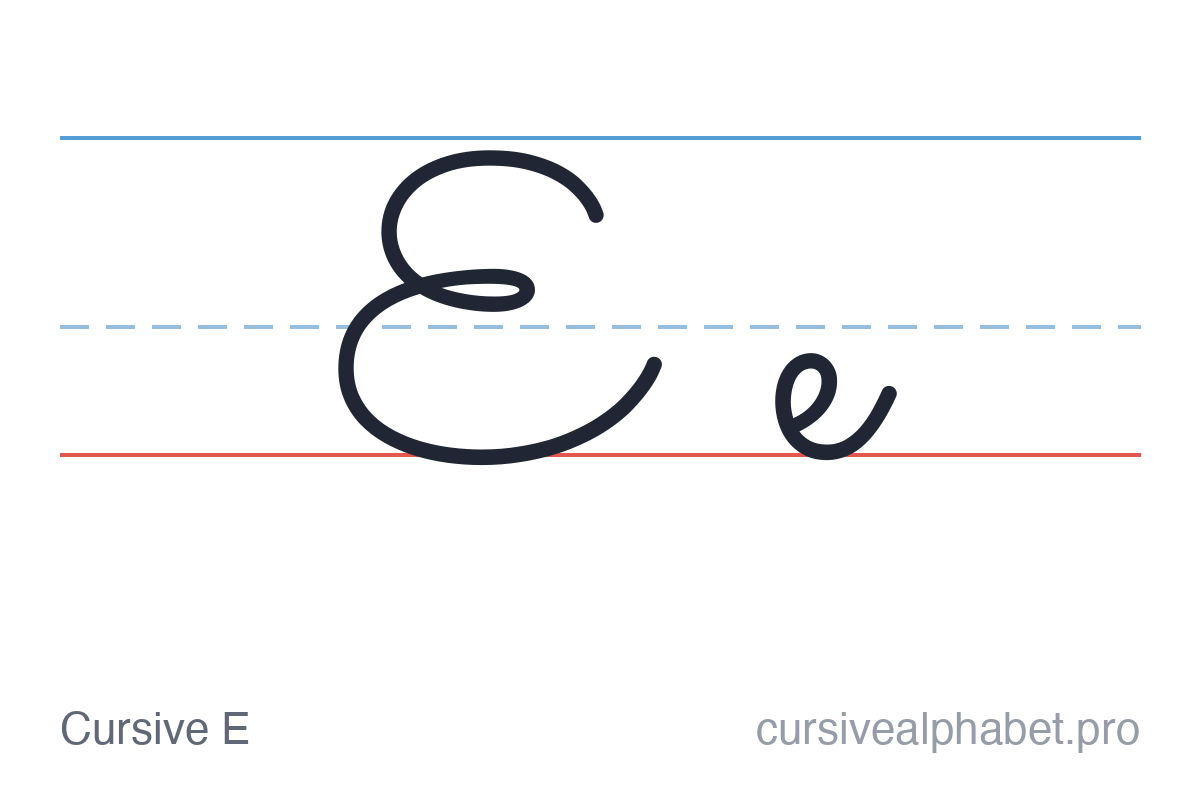
How to write uppercase E and lowercase e in cursive, one stroke at a time.
Cursive e is the most common letter in English writing, so it is worth getting perfect. It is a small loop: an undercurve up to the midline that turns back on itself. Keep the loop open and you will never confuse it with i or c. The capital E is a doubled curve, like a backward 3 with a small loop in the middle.
- Stroke family
- Undercurve letters
- Height
- e is a short letter — it stays between the baseline and the midline. e and the other short letters
- Joins the next letter
- Lowercase: yes, from the baseline. Capital: yes. The baseline join e uses
How to write a lowercase e in cursive
Start just above the baseline; finish at the baseline, with an exit tail. One continuous stroke.
- Start a little above the baseline with an undercurve that rises to the right toward the midline.
- At the midline, loop back to the left and down, crossing your rising stroke and returning to the baseline.
- Finish with an undercurve out to the midline for the next letter.
Trace cursive e on screen with a finger or mouse — the board tells you if you start in the wrong place or go the wrong way.
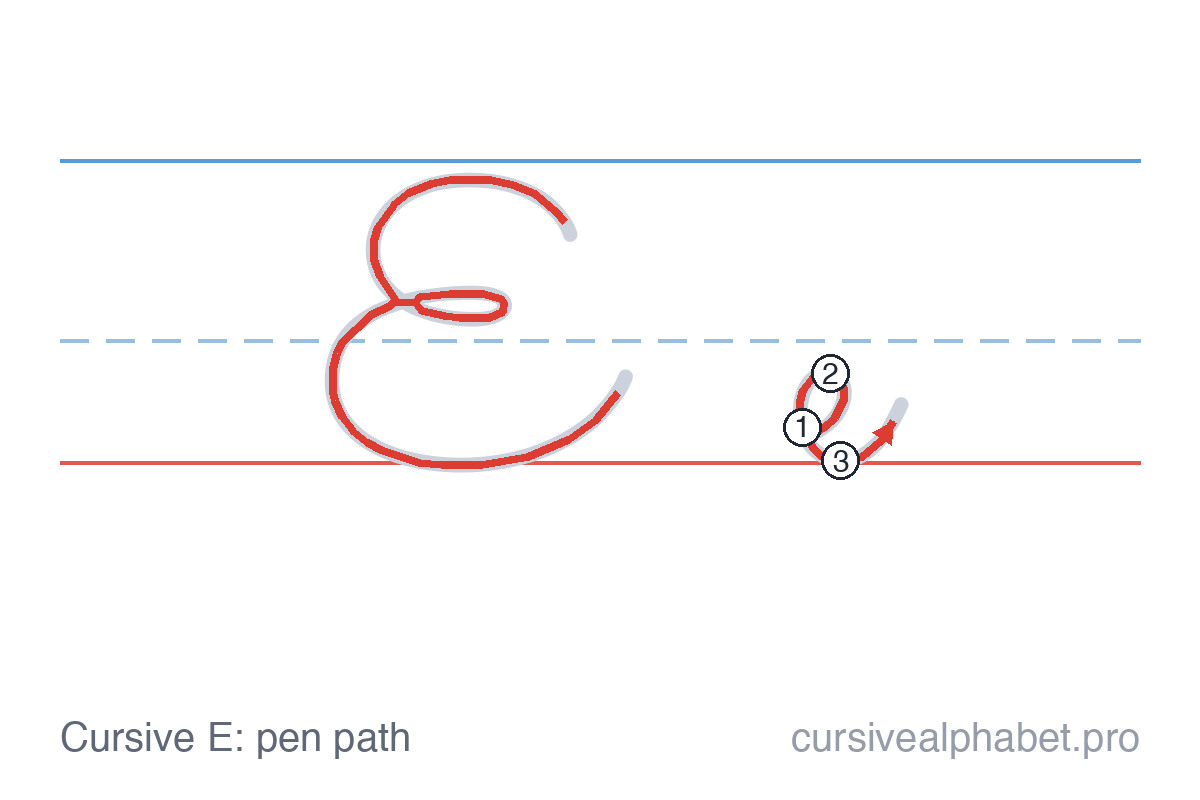
Lowercase cursive e — numbers mark where each part of the stroke begins
Capital cursive E — numbers mark where each part of the stroke begins
How to write a capital E in cursive
Start just below the top line, on the right; finish at the baseline, with an exit tail. Capital E ends with an exit stroke, so it joins the lowercase letter that follows without lifting the pen. E beside the other capitals that join
- Start just below the top line with a small hook, then curve up and around to the left and down to the midline, forming the upper curve.
- At the midline make a small loop that points to the right.
- Continue with a second, slightly larger curve down to the baseline and end with an undercurve to the midline.
Common mistakes with cursive E
- Closing the loop so it becomes a solid line — that turns e into i.
- Making the loop too tall; e is a midline letter and should never rise above the dashed line.
- Pausing at the top: the loop must be written in one motion or it gets a corner.
Tips that help
- Practice "ee" and "ele" in a row to lock in a steady rhythm — e is all about consistent loop size.
- After a bridge letter (b, o, v, w), the e starts at the midline and its loop is drawn from there.
Easy to mistake for l
The same loop at two heights: e stops at the dashed midline, l climbs all the way to the top line. Cursive l
Can you tell e from l at a glance? Take the reading test · Print a comparison practice sheet
Practice words with e
Once the letter is comfortable on its own, write it inside words — that is where the joins happen. Watch how the exit tail of e rises to meet the next letter.
Want different words? Type a spelling list into the generator and print your own e sheet (letters A–Z and numbers, up to 24 lines of any length, US Letter or A4), or copy more words that use e from the word lists.
Free cursive E worksheet
Capital E and lowercase e: a model to copy, grey letters to write over, dotted letters to trace, two practice words, and blank rows to finish on your own. Prints on one US Letter page.
Cursive E practice sheet
Uppercase E · lowercase e · egg · every
Name ______________________ Date __________
Capital E
Lowercase e
Together
Words
On your own
cursivealphabet.pro — free cursive practice sheets
e and its stroke family
Undercurve letters begin with a stroke that swings up from the baseline: i, u, w, t, j, p, r, s, e, l, b, h, k and f. Learn i and u first — every other letter in the group is built on that same entry stroke.
Families are also the order to learn in, rather than A to Z: the beginner’s guide covers when e is usually taught and the four strokes every letter is built from.
Cursive E questions
How do you write a lowercase e in cursive?
Undercurve from the baseline up to the midline, loop back to the left and down across your own stroke to the baseline, then exit with a tail. The whole letter is one small loop.
How do you write a capital E in cursive?
Draw two stacked curves from the top line to the baseline with a small loop between them at the midline, then finish with a tail. It resembles a backward 3 with a knot in the middle, and it connects to the next letter.
How is cursive e different from cursive i?
Both start with the same undercurve, but e loops back on itself while i goes straight back down along the same path and gets a dot. An open loop means e; a closed retrace with a dot means i.
What are some good words to practise cursive e with?
Good practice words for cursive e are egg, every, eagle, eleven and easy. The join is what to watch: the undercurve out of e has to reach the baseline before the next letter starts, or the two run together. Watch the height too: e should stop at the midline, level with the short letters either side of it. The practice sheet on this page rules the first two, egg and every; the worksheet generator will rule the rest.
Cursive Alphabet — cursive E