Cursive D
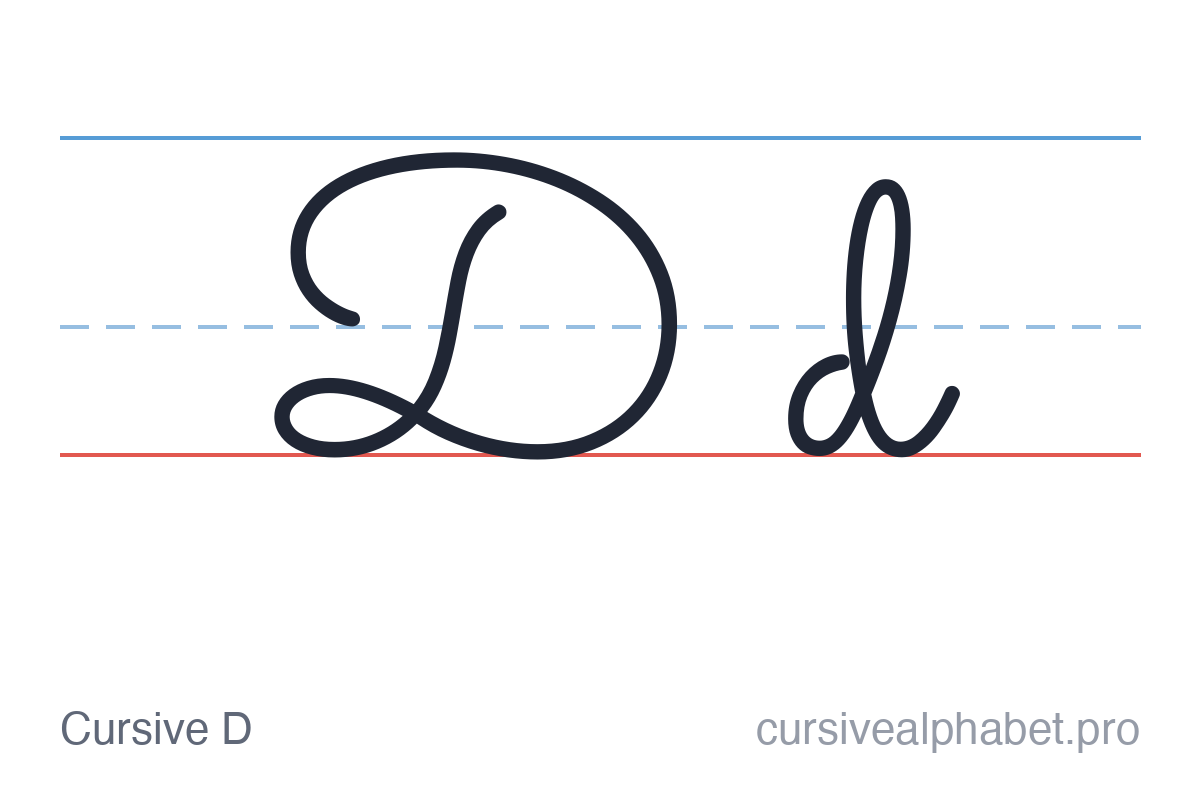
How to write uppercase D and lowercase d in cursive, one stroke at a time.
Cursive d is an a with a tall stem. The oval is identical to a; the difference is that the stem rises toward the top line and comes back down. In these letterforms the d stem is a narrow loop that stops short of the top line (many classroom programs retrace it instead), and its slim, short stem is the quickest way to tell d from a badly written b or l.
- Stroke family
- Downcurve (oval) letters
- Height
- d is a tall letter — it reaches up to the top line. d and the other tall letters
- Joins the next letter
- Lowercase: yes, from the baseline. Capital: no — lift the pen. The baseline join d uses
How to write a lowercase d in cursive
Start at the midline; finish at the baseline, with an exit tail. One continuous stroke.
- Start at the midline. Curve counter-clockwise down to the baseline and round back up to close the oval, exactly as for a.
- Continue the stroke up past the oval to just below the top line to form the stem.
- Loop narrowly over to the left and come back down the stem to the baseline, then finish with an undercurve to the midline.
Trace cursive d on screen with a finger or mouse — the board tells you if you start in the wrong place or go the wrong way.
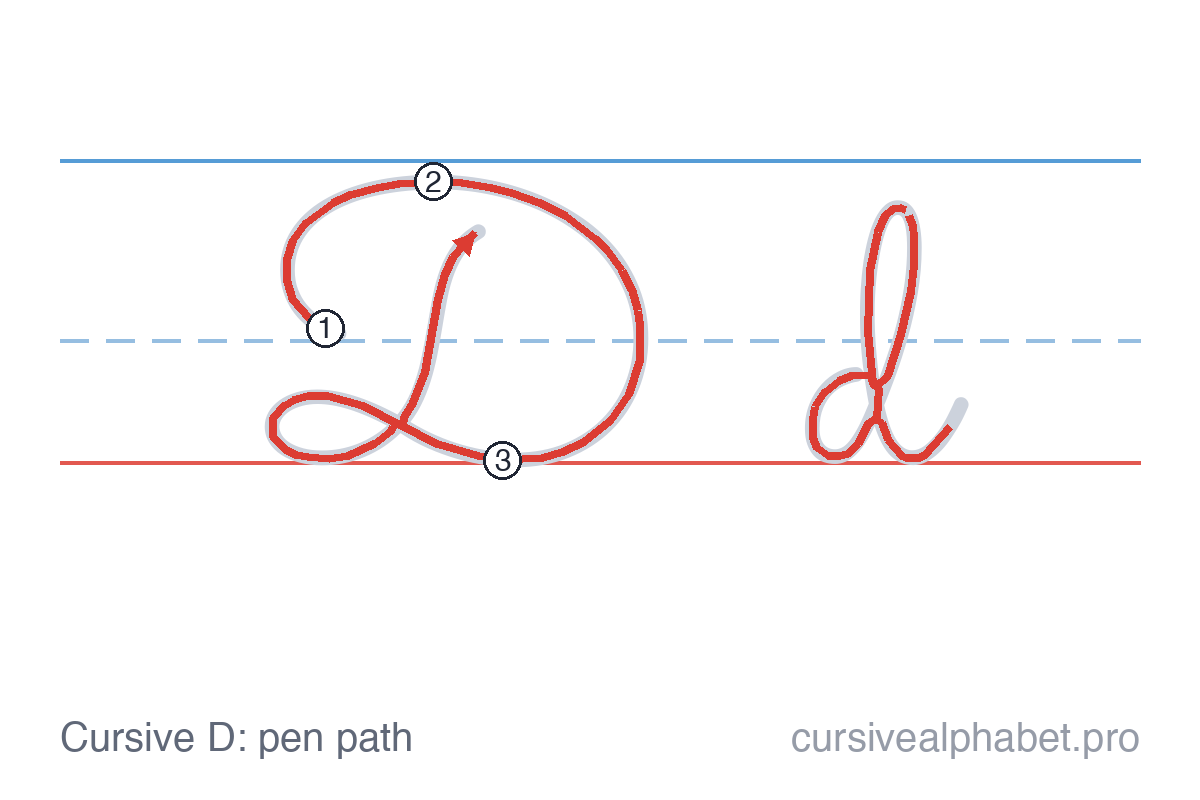
Lowercase cursive d — numbers mark where each part of the stroke begins
Capital cursive D — numbers mark where each part of the stroke begins
How to write a capital D in cursive
Start at the top of the stem; finish at the midline on the left, with a small curl (pen lifts). Capital D does not join the next letter: finish it, lift the pen, and begin the next letter on its own. D beside the other capitals that need a pen lift
- Start just below the top line and draw a slant stroke down to the baseline.
- At the bottom, make a small loop that swings to the left and back across the stem.
- Run along the baseline and curve up and around to the right in one large arc, over the top and down the left side, ending in a small curl at the midline.
Common mistakes with cursive D
- Making the stem loop as wide and tall as the loop of b, which turns the d into a b-like shape.
- Leaving the oval open, so the letter reads as "cl".
- Making the stem too short, which makes d and a indistinguishable at a glance.
Tips that help
- Write "ad" and "da" side by side: the two letters share the same oval, so keep them the same size.
- The stem of d should reach about the same height as t — a little below the top line.
Cursive D, then and now
If you learned cursive from an older relative, or you are reading old handwriting, you may know this letter from the Palmer Method, the business hand that Zaner-Bloser eventually replaced in American schools. Here are the two side by side.
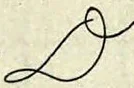
Palmer letters from A. N. Palmer’s The Palmer Method of Business Writing, a public-domain scan on Wikimedia Commons.

“I was never able to do a capital D. So I always print it. I used to try doing an unattached loop in the lower left corner but that was too much trouble lol”
Which one to use
The bottom-left loop is the step people skip, and without it the letter looks unfinished. Practise it alone first: slant down, small loop, and carry straight on into the bowl without lifting.
Where Palmer, Zaner-Bloser and D’Nealian came from, and how their letters differ
Practice words with d
Once the letter is comfortable on its own, write it inside words — that is where the joins happen. Watch how the exit tail of d rises to meet the next letter.
Want different words? Type a spelling list into the generator and print your own d sheet (letters A–Z and numbers, up to 24 lines of any length, US Letter or A4), or copy more words that use d from the word lists.
Free cursive D worksheet
Capital D and lowercase d: a model to copy, grey letters to write over, dotted letters to trace, two practice words, and blank rows to finish on your own. Prints on one US Letter page.
Cursive D practice sheet
Uppercase D · lowercase d · dog · day
Name ______________________ Date __________
Capital D
Lowercase d
Together
Words
On your own
cursivealphabet.pro — free cursive practice sheets
d and its stroke family
Downcurve (oval) letters begin at the midline with a counter-clockwise curve that rounds down and back up: a, d, g, o and q close the oval, c leaves it open. Master that curve once and you have six letters.
Families are also the order to learn in, rather than A to Z: the beginner’s guide covers when d is usually taught and the four strokes every letter is built from.
Cursive D questions
How do you write a lowercase d in cursive?
Make the oval of an a, then instead of a short stem, run the stroke up to just below the top line, loop narrowly and come back down to the baseline, and exit with a tail. The stem loop is much slimmer than the loop of b.
How do you write a capital D in cursive?
Slant down from just below the top line, make a small loop at the baseline that crosses the stem, then sweep along the bottom and up around the right in a big arc, over the top and down the left side to a small curl. Capital D does not connect to the next letter.
Is cursive d looped like b?
Only narrowly. The d stem is a thin loop that stops short of the top line, while b, f, h and l have wide loops that reach it. Many classroom programs retrace the d stem instead of looping it; either way, it should be clearly slimmer and shorter than a b.
What are some good words to practise cursive d with?
Good practice words for cursive d are dog, day, dance, doodle and dream. Close the oval of d each time before you move on; an oval left open at speed is the usual way it stops reading as d. Watch the stem too: d rises above the midline but stops short of the top line, and comes straight back down the same line. The practice sheet on this page rules the first two, dog and day; the worksheet generator will rule the rest.
Cursive Alphabet — cursive D