Cursive O
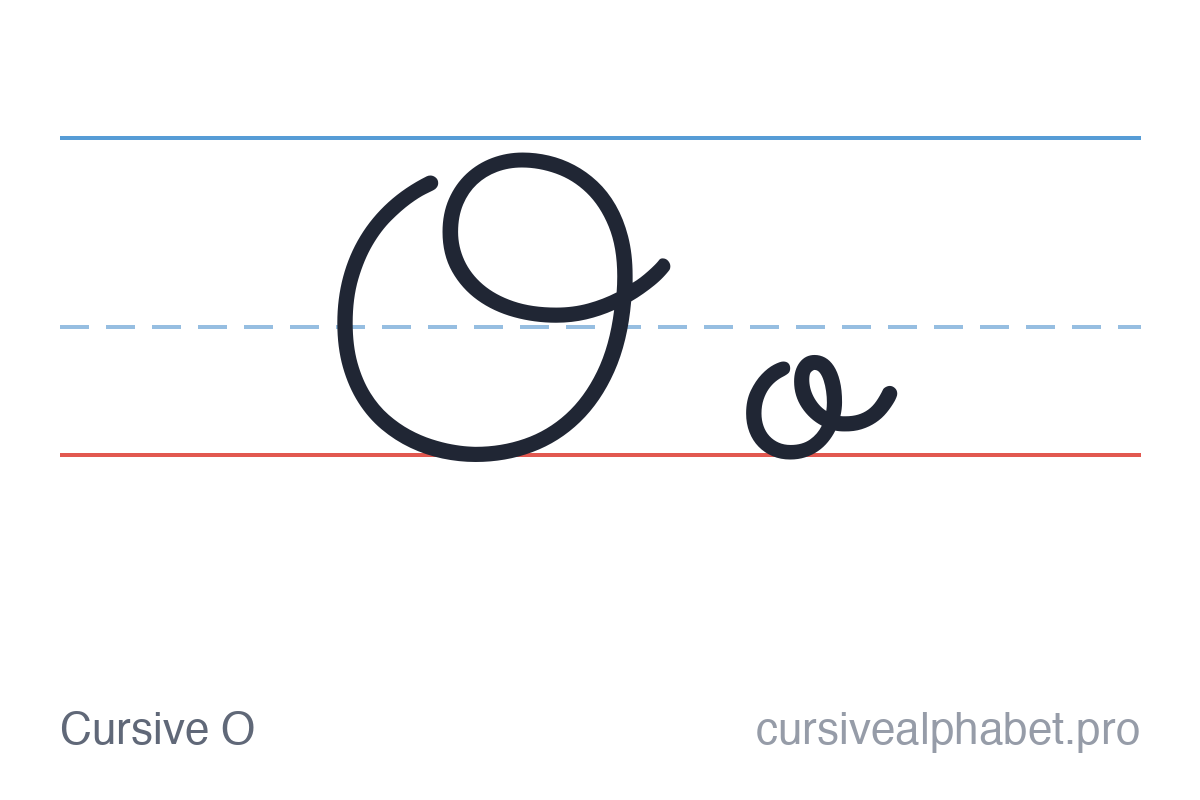
How to write uppercase O and lowercase o in cursive, one stroke at a time.
Compare o with a and practise whole words, not just the oval on its own.
Cursive o is an oval with a small loop on its right side, and it is a bridge letter: the loop lifts the exit, so it leaves as a short bridge rather than a tail along the baseline. That changes how the next letter begins, so "ov", "or" and "os" are worth practising. The capital O is the same oval grown to the top line, with a loop that curls down inside it.
- Stroke family
- Downcurve (oval) letters
- Height
- o is a short letter — it stays between the baseline and the midline. o and the other short letters
- Joins the next letter
- Lowercase: yes, from the midline (bridge). Capital: no — lift the pen. The bridge join o uses
How to write a lowercase o in cursive
Start at the midline; finish at the midline, with a short bridge stroke. One continuous stroke.
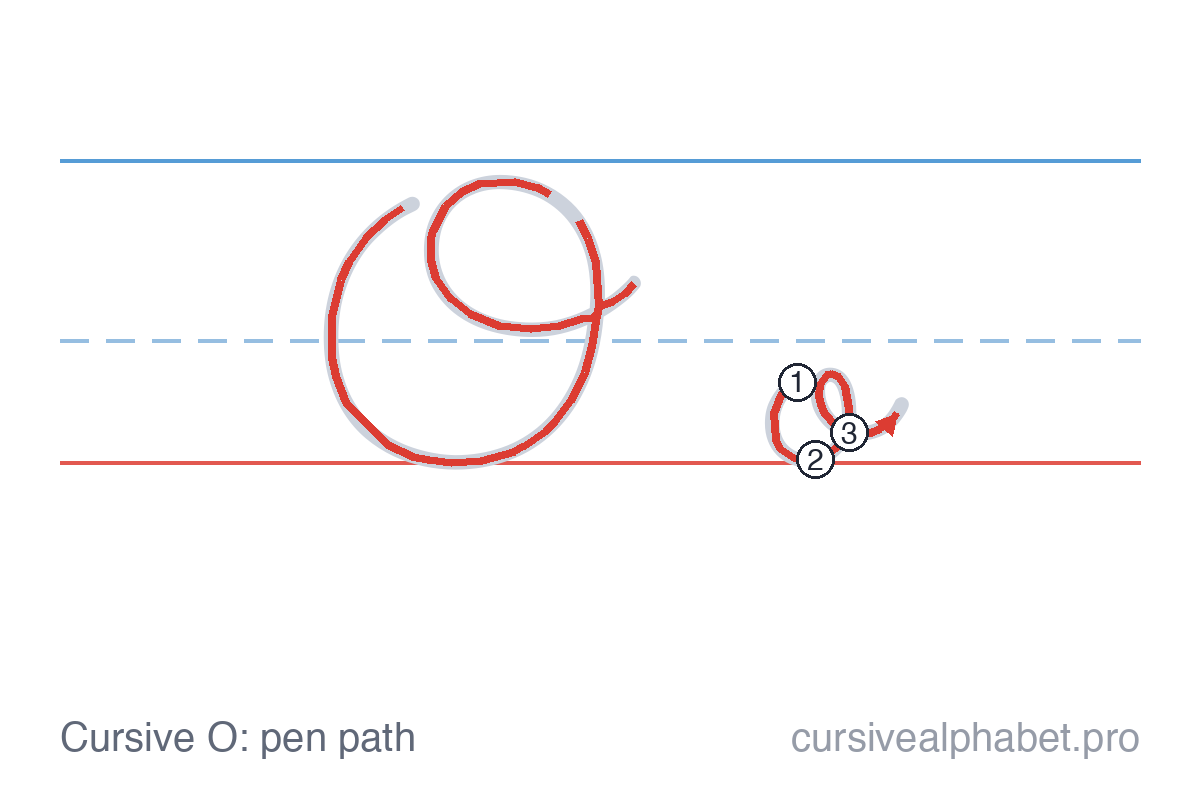
- Start at the midline. Curve back to the left and down (counter-clockwise) to the baseline.
- Round along the bottom and up the right side to a crossing just above the baseline.
- Carry on up into a loop that reaches the midline, over to the left and back down to the crossing, then finish with a short bridge to the right for the next letter.
Trace cursive o on screen with a finger or mouse — the board tells you if you start in the wrong place or go the wrong way.
Lowercase cursive o — numbers mark where each part of the stroke begins
Capital cursive O — numbers mark where each part of the stroke begins
How to write a capital O in cursive
Start just below the top line, on the left; finish above the midline, with a short stroke to the right (pen lifts). Capital O does not join the next letter: finish it, lift the pen, and begin the next letter on its own. O beside the other capitals that need a pen lift
- Start just below the top line on the left and sweep down (counter-clockwise) to the baseline.
- Round along the bottom and back up the right side to the top line, leaving the oval open where you began.
- Carry on over the top into a loop that curls down inside the oval, then cross the right side and finish with a short stroke to the right.
Keep lowercase o from turning into a
In this original letter model, both letters have a closed oval. The useful difference is where the letter finishes: follow the exit, not just the round shape.
a closes its oval and comes down to the baseline before the next letter. o leaves from the top and joins along the midline.
Check o inside a word
- Read some and same before writing them. Keep the vowel clear enough that someone else can tell which word you meant.
- Write noon and moon slowly. Close each oval before moving into the next letter.
- Cover the model and copy a word on the blank line. Check the ovals and letter spacing before writing another row.
For continuous paths rather than separate letterforms, try the experimental joining lab. Its letter shapes differ from the original model shown here.
Can you read back some and same?
Copy on paper, hide the model, then write once from memory. Show it again to compare. Tick only the checks you have actually made.
Read both words first. The vowel is o in some and a in same; the other letters stay the same.
In this model, o exits near the midline, while a returns to the baseline before its exit. If both endings look alike on your paper, retry the vowels separately. Check lowercase a.
Cover the model and write some and same on a blank line. Show it again and check that another reader could distinguish the vowels.
0 of 3 checks recorded. Leave a check unticked if you want to try it again.
These are your own observations, not an automatic handwriting score. They reset when you leave or reload this page.
If the oval itself is still open, try the short oval warm-up before repeating the words.
Lowercase o and a comparison worksheet
One US Letter page with models, tracing, dotted words and blank lines. These are original letterforms placed separately, not a continuous joined-path model.
Lowercase o and a: compare and practise
o / a · some / same · noon / moon
Name ______________________ Date __________
Compare the exit
Read the vowel before copying
Two ovals in one word
Write from memory
cursivealphabet.pro — free cursive practice sheets
Common mistakes with cursive O
- Exiting from the baseline instead of the midline, which turns o into an a.
- Leaving the oval open at the top, which makes it read as u.
- Making the bridge stroke too long, so a gap opens before the next letter.
Tips that help
- o is a with no stem: same oval, same slant, but the stroke keeps going over the top instead of dropping down.
- Letters after o start at the midline — "on" and "om" begin their hump straight from the bridge.
Easy to mistake for a
a closes its oval and comes down to the baseline before the next letter. o leaves from the top and joins along the midline. Cursive a
Can you tell a from o at a glance? Take the reading test · Print a comparison practice sheet
Practice words with o
Once the letter is comfortable on its own, write it inside words — that is where the joins happen. Because o is a bridge letter, watch how the letter after it starts from the midline.
Want different words? Type a spelling list into the generator and print your own o sheet (letters A–Z and numbers, up to 24 lines of any length, US Letter or A4), or copy more words that use o from the word lists.
Free cursive O worksheet
Capital O and lowercase o: a model to copy, grey letters to write over, dotted letters to trace, two practice words, and blank rows to finish on your own. Prints on one US Letter page.
Cursive O practice sheet
Uppercase O · lowercase o · owl · open
Name ______________________ Date __________
Capital O
Lowercase o
Together
Words
On your own
cursivealphabet.pro — free cursive practice sheets
o and its stroke family
Downcurve (oval) letters begin at the midline with a counter-clockwise curve that rounds down and back up: a, d, g, o and q close the oval, c leaves it open. Master that curve once and you have six letters.
Families are also the order to learn in, rather than A to Z: the beginner’s guide covers when o is usually taught and the four strokes every letter is built from.
Cursive O questions
How do you write a lowercase o in cursive?
Start at the midline, curve counter-clockwise down to the baseline and back up the right side, loop up to the midline and back, then finish with a short bridge to the right. It is one stroke that ends high.
How do you write a capital O in cursive?
Draw a large oval counter-clockwise from high on the left down to the baseline and back up to the top, then curl a loop down inside it and out through the right side. Capital O does not connect to the next letter.
Why does cursive o connect at the top?
Because its loop carries the stroke back up before it leaves, so the exit is a bridge rather than a baseline tail. o, b, v and w are the four bridge letters; the letter after them starts from the midline.
What are some good words to practise cursive o with?
Good practice words for cursive o are owl, open, orange, ocean and over. Close the oval of o each time before you move on; an oval left open at speed is the usual way it stops reading as o. Watch the height too: o should stop at the midline, level with the short letters either side of it. The practice sheet on this page rules the first two, owl and open; the worksheet generator will rule the rest.
Cursive Alphabet — cursive O