Cursive R
How to write uppercase R and lowercase r in cursive, one stroke at a time.
Cursive r is short, but it is one of the letters people most often get wrong, because its "shoulder" is easy to overdo. It begins with an undercurve like i, then makes a small loop at the midline, runs level along its shoulder, and slants down. The capital R is a P with an extra leg.
- Stroke family
- Undercurve letters
- Height
- r is a short letter — it stays between the baseline and the midline. r and the other short letters
- Joins the next letter
- Lowercase: yes, from the baseline. Capital: yes. The baseline join r uses
How to write a lowercase r in cursive
Start halfway up to the midline; finish at the baseline, with an exit tail. One continuous stroke.
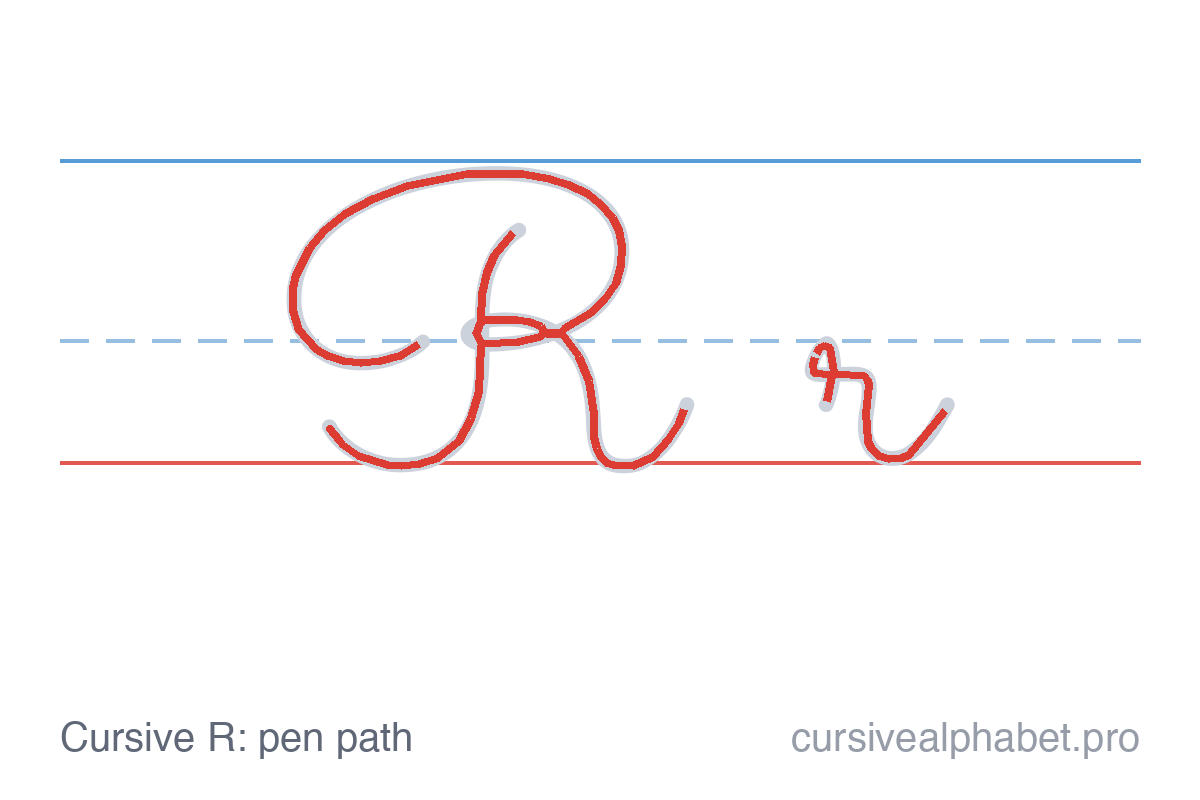
- Start about halfway up to the midline with an undercurve up to the midline.
- At the midline, make a small loop up and over to the left, then run level to the right — this is the shoulder.
- Slant down to the baseline and finish with an undercurve to the midline.
Trace cursive r on screen with a finger or mouse — the board tells you if you start in the wrong place or go the wrong way.
Lowercase cursive r — numbers mark where each part of the stroke begins
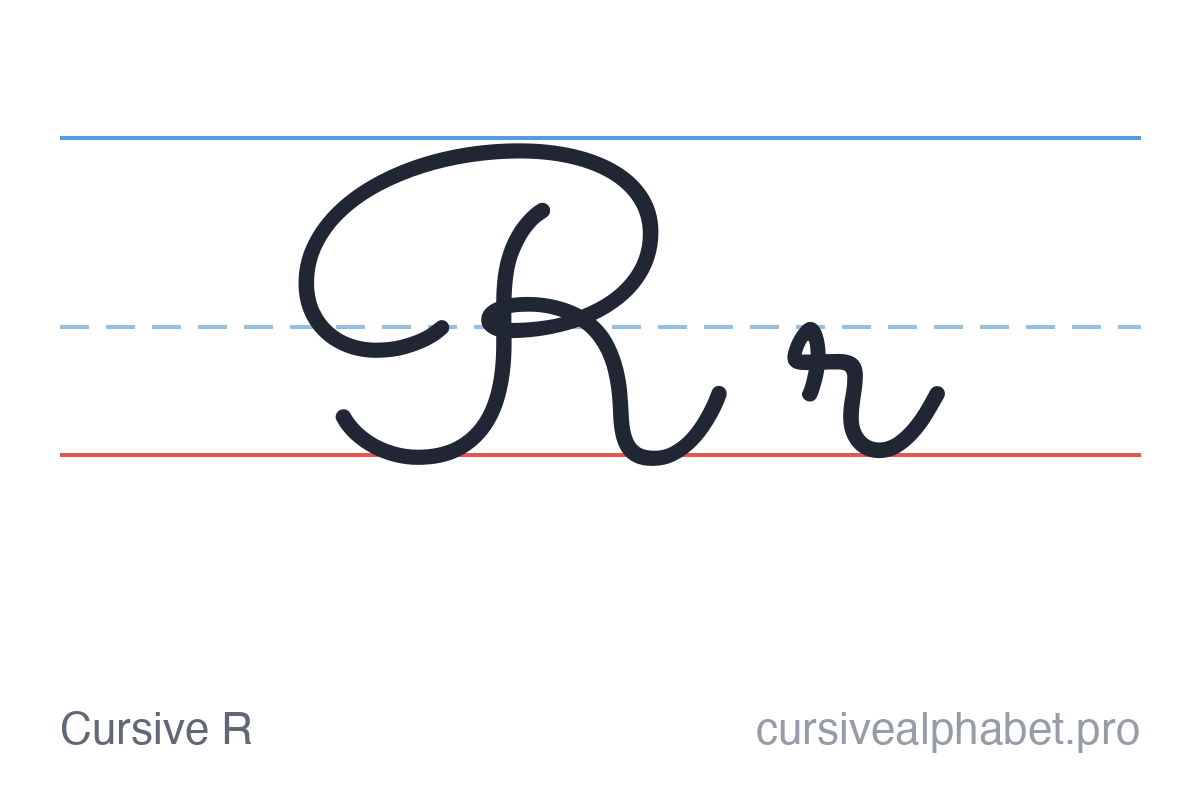
Capital cursive R — numbers mark where each part of the stroke begins
How to write a capital R in cursive
Start at the top of the stem; finish at the baseline, with an exit tail. Capital R ends with an exit stroke, so it joins the lowercase letter that follows without lifting the pen. R beside the other capitals that join
- Start just below the top line and draw a slant stroke down to the baseline, curling to the left at the bottom.
- Lift the pen. Start the bowl at the midline to the left of the stem, swing left and up over the top line, and round down on the right to meet the stem at the midline in a small loop.
- From the midline, slant down and out to the right to the baseline and finish with an undercurve to the midline.
Common mistakes with cursive R
- Making the shoulder too tall or too wide, so the r reads as an n.
- Skipping the shoulder and writing a plain i without a dot — the small loop and shoulder are what make it an r.
- Rushing the r at the end of a word ("her", "for") into a shapeless bump.
Tips that help
- Think of r as an i with a little shelf on top.
- Write "ir", "er" and "or" — the r after a bridge letter (o) starts at the midline and its shoulder sits right on the bridge.
Easy to mistake for v or s
v has a pointed bottom and leaves from the midline with a small loop. r has a little flat step at the top, then comes down to the baseline. Cursive v
s rises to a point and closes into a small round bottom. r makes a small loop at the top, takes a short flat step to the right, and only then comes down. Cursive s
Can you tell v from r at a glance? Take the reading test · Print a comparison practice sheet
Cursive r, then and now
If you learned cursive from an older relative, or you are reading old handwriting, you may know this letter from the Palmer Method, the business hand that Zaner-Bloser eventually replaced in American schools. Here are the two side by side.
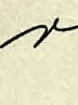
Palmer letters from A. N. Palmer’s The Palmer Method of Business Writing, a public-domain scan on Wikimedia Commons.

“Some of the letters in Palmer are not what I remember doing, specifically the letters b, r, and s.”
Which one to use
Loop or point, the shoulder is what makes it an r. Keep it short and level: when the shoulder tilts or stretches, r starts to look like a v or an s.
Where Palmer, Zaner-Bloser and D’Nealian came from, and how their letters differ
Practice words with r
Once the letter is comfortable on its own, write it inside words — that is where the joins happen. Watch how the exit tail of r rises to meet the next letter.
Want different words? Type a spelling list into the generator and print your own r sheet (letters A–Z and numbers, up to 24 lines of any length, US Letter or A4), or copy more words that use r from the word lists.
Free cursive R worksheet
Capital R and lowercase r: a model to copy, grey letters to write over, dotted letters to trace, two practice words, and blank rows to finish on your own. Prints on one US Letter page.
Cursive R practice sheet
Uppercase R · lowercase r · red · rain
Name ______________________ Date __________
Capital R
Lowercase r
Together
Words
On your own
cursivealphabet.pro — free cursive practice sheets
r and its stroke family
Undercurve letters begin with a stroke that swings up from the baseline: i, u, w, t, j, p, r, s, e, l, b, h, k and f. Learn i and u first — every other letter in the group is built on that same entry stroke.
Families are also the order to learn in, rather than A to Z: the beginner’s guide covers when r is usually taught and the four strokes every letter is built from.
Cursive R questions
How do you write a lowercase r in cursive?
Undercurve up to the midline, make a small loop over to the left and run level to the right (the shoulder), then slant down to the baseline and exit with a tail. It is one stroke, and the shoulder is small.
How do you write a capital R in cursive?
Draw a stem from the top line to the baseline, lift the pen, then draw a bowl from the midline up over the top that comes round to meet the stem in a small loop, and slant the leg down to the baseline with a tail. Capital R connects to the next letter.
Why is cursive r so hard to read?
Because its shoulder is tiny and easily blurs into the surrounding letters. Keep the shoulder short and level after its small loop, and make sure the letter is no taller than the midline.
What are some good words to practise cursive r with?
Good practice words for cursive r are red, rain, river, rabbit and ribbon. The join is what to watch: the undercurve out of r has to reach the baseline before the next letter starts, or the two run together. Watch the height too: r should stop at the midline, level with the short letters either side of it. The practice sheet on this page rules the first two, red and rain; the worksheet generator will rule the rest.
Cursive Alphabet — cursive R